
Nanoscience in 2026 doesn’t really make front-page news the way it did a couple of decades ago, back when headlines were all about magical-sounding new materials and tiny machines. The field has matured—a lot. Instead of big splashy breakthroughs or wild predictions, what’s happening now is more like a quiet shift: discoveries from the lab are just quietly becoming part of the everyday tech that runs everything from our power grids to our phones, our medicines, our factories, and beyond. Today, the real story isn’t about showy new inventions, but about how nanoscience has become dependable, repeatable, and actually useful at an industrial scale. It’s less about the spotlight and more about the foundation—the invisible tech making everything else work better.
Take materials science. We’ve reached a point where scientists can pretty much design how materials behave, atom by atom. Two-dimensional materials, for example, aren’t replacing silicon like folks once guessed—they’re working alongside it, in layered stacks where the way those layers interact actually matters more than what the layers are made of. Researchers have figured out how to routinely tweak these nano-layers, creating just the right “defects” or structuring grain boundaries to fine-tune things like electrical charge, heat flow, or even how a material responds to light. These sorts of precise tweaks lead to steady, building improvements in everything from sensors to high-powered electronics—especially in the kinds of environments where old-school materials start to hit their limits.
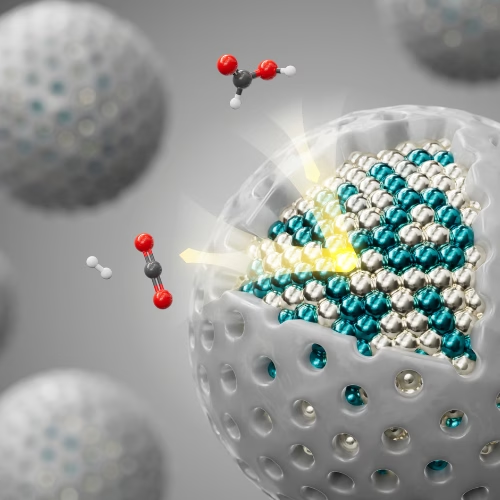
Then there’s energy. If you want to see nanoscience making a real difference, batteries are a great place to look. Instead of searching for some brand new chemistry, a lot of progress now comes from controlling what’s happening at the level of ions moving around, or how batteries break down over time, all at the nanoscale. So, solid-state batteries, new anode and cathode designs—these advances all depend on clever ways of building things at the tiny level. And it’s not just about making batteries last longer or store more; similar ideas help with hydrogen production, clean fuels, and efficient electrolysis. Small gains—better surface area here, more stable active sites there—add up to technologies that actually do more, reliably.
In electronics and computing, nanoscience has sort of redefined how we think about “making things smaller.” We’ve run into the physical limits of shrinking transistors the old way, so now engineers work in three dimensions, creating new types of gates or materials right down to the atomic scale. Ferroelectric layers, phase-change materials, components that use the spin of electrons—all these are shifting the field toward memory and processing that are more energy-efficient and increasingly specialized. Plus, techniques from nanoscience are behind today’s advances in things like photonics and high-density packaging, where it’s how close you can pack things and manage their heat, instead of just counting transistors, that determines how powerful and efficient a chip can be.
Medicine’s story is even more down-to-earth than all those old sci-fi visions of tiny robots swimming through your veins. The focus now is on using nanoparticles as smart delivery vehicles for drugs—tuned so your immune system tolerates them, and your body gets medicine where it’s supposed to go, in the right dose at the right time. Diagnostics are another big area. Nano-sized sensors can spot disease markers at incredibly low levels, letting doctors catch things earlier and tailor treatments on a very personal level. And as these technologies mature, there’s an increasing push to make sure they’re safe, stable, and actually manufacturable—because a great new medical tool can only matter if it works reliably for real people, not just in a lab.
Manufacturing is another area where nanoscience is changing things, often in ways most of us never notice. Stronger coatings, surfaces that resist wear, thin films that improve tools or industrial equipment—all made possible thanks to nanoscale engineering. Even 3D printing is getting a boost as materials with nano-fillers or reinforcements give products custom properties without making them harder to produce. The main point: nanoscience isn’t sitting in its own silo anymore. It’s baked into how products are designed and built, quietly improving the performance and durability of things we use every day.
Looking ahead, the really interesting new leaps in nanoscience probably won’t come from one field alone. AI is starting to change how scientists experiment at the nanoscale, using algorithms to sift through complex options far faster than humans could alone. The whole area of quantum technology, for instance, relies on being able to control things at a ridiculously tiny scale. Plus, with growing concern about sustainability, a lot of today’s research aims for materials and devices that use fewer resources, are easier to recycle, or simply last longer.
So, what sets nanoscience apart now isn’t any one big breakthrough or bold prediction—it’s the fact that it’s everywhere, humming along in the background, making all sorts of existing technology better and more efficient. Gone are the days when the field had to make the case for its own importance. Now, it’s about integration: nanoscience is woven into the systems we rely on, quietly pushing the limits of what’s possible in ways most people never even notice. And as this keeps unfolding, its influence is only going to deepen over the years ahead.