
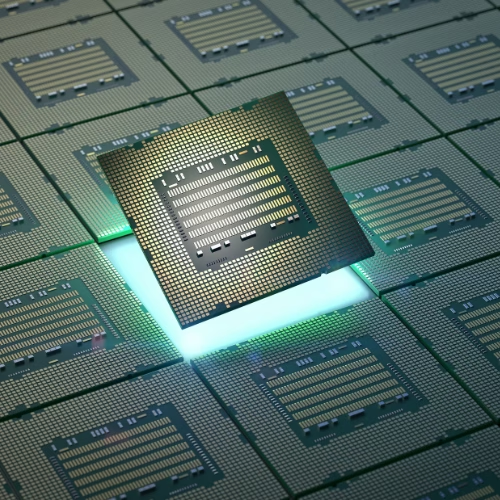
The story of the semiconductor industry isn’t about one big breakthrough or a single invention. Instead, it really grew out of a blend of scientific fields like solid-state physics and materials science, plus a healthy dose of practical problem-solving from early manufacturing. Back in the early 1900s, scientists started digging into how electrons move in crystalline solids, and they realized that adding certain impurities—what we now call doping—could radically change how electricity flows through these materials. The big “aha” moment was discovering materials that sit between good conductors and insulators, and more importantly, that you can actually control how much electricity they let through. Once that was understood, semiconductors transformed from lab curiosities into the foundation of everything from radios to computers, taking us away from the days of bulky vacuum tubes and into an era of smaller, more reliable, and energy-saving electronics.
Those early semiconductor devices were pretty basic compared to what we’ve got now. Still, the ideas behind them haven’t really changed. By carefully mixing in different atoms—dopants—engineers figured out how to make some regions with extra electrons and others with “holes” where electrons could go. Getting these regions just right let them design junctions that could control the flow of current, turning it on and off or letting it move in only one direction. That’s the core idea behind diodes and transistors, which is what lets us amplify signals, handle information, and control power with precision. Pretty soon, the industry shifted gears from making individual parts to squeezing loads of devices onto a single chip—integrated circuits. This wasn’t exactly a new scientific idea, but more about mastering complicated manufacturing and being able to repeat incredibly detailed processes over and over with almost no mistakes.
One thing that really stands out in semiconductor history is how much more powerful these chips have become, decade after decade. Engineers kept shrinking the parts and finding cleaner, sharper ways to make them, so now there are billions of transistors on a chip that’s only a few centimeters wide. They didn’t just get there by making everything smaller—they had to invent new ways to lay down and shape materials, like precision lithography and thin-film deposition. Even etching and layering got more sophisticated. Everything comes down to controlling matter at the nanometer scale. Tiny imperfections, surfaces, and atomic-level roughness can suddenly make or break a device’s performance. In the end, nanoscience isn’t an optional bonus—it’s essential.
These days, semiconductors do way more than just run computers. They’re packed into electric vehicles, clean energy systems, and automated factories, working behind the scenes to regulate and manage all sorts of power flows. Sensors in medical devices, tools that track air quality, and smart city gadgets all lean on advanced chips to turn physical data (like temperature or chemicals in the air) into something digital we can use. Even regular home appliances work more efficiently because of highly specialized chips that focus on control and connectivity rather than just raw processing power. Communication, too—everything from Wi-Fi to fiber-optic networks—relies on semiconductors that handle signals across a huge range of frequencies, quietly connecting the world.
Making one of these modern chips is basically a nanoscale project from start to finish. It starts with a perfect crystal substrate—usually grown in super-clean conditions to keep out tiny flaws that can ruin things later. Onto that base, engineers add dozens of layers, sometimes only a few atoms thick, shaping and tweaking them through a precise dance of chemical and physical processing steps. Lithography carves out patterns at almost impossibly small sizes, while other techniques like plasma etching and atomic-layer deposition help build and sculpt each layer. Doping—remember those purposeful impurities?—gets mapped out in both amount and location, adjusting things over stretches just a handful of nanometers wide so the electric fields and carrier motion behave exactly as needed. At this level, the usual rules of physics hit their limits, and quantum effects or random atomic variations start to matter—and designers have to take all that into account.
Nanoscience really does double duty here. For one thing, it gives us the scientific tools to figure out what’s happening in these impossibly small regions. But on top of that, it powers the systems and processes that let manufacturers make this knowledge useful at massive scale. Improvements in nanoscale measurements—figuring out layer thickness, what elements are present, and how defect-free everything is—feed directly back into process controls to make sure things run smoothly all the way through the fab. If you didn’t have this tight loop between science and industrial ops, the whole industry would stall.
What’s truly unique about semiconductors is that they’re now baked into practically every other industrial sector. They don’t just exist as a self-contained industry—they’re like a force multiplier, sparking progress everywhere that matters—whether it’s information, power efficiency, or control. The way forward isn’t so much about big, dramatic discoveries anymore, but about making countless small improvements at the nanoscale. Tweaking the materials, perfecting interfaces, and fine-tuning the way devices are built—all those little steps add up. Semiconductors aren’t just a product of nanoscience; they’re one of its clearest success stories. It’s a perfect example of how getting control at the tiniest scales can completely reshape the technology that all of us rely on every day.